
Take your technology from the lab to flight.
Stratospheric and suborbital qualification testing for space hardware and experiments.
Validate your payload in relevant flight environments, collect real-world data and reduce risk before committing to an orbital mission.
You don't have to choose both options before your space journey. Working with your Mission Manager helps you identify the fastest path.
A structured pathway from laboratory development to real flight testing.
Lab2Space gives researchers, startups, universities, government organisations and technology developers access to real flight environments without requiring them to build an entire flight program themselves.
Orbit2Orbit supports the mission from early payload assessment through engineering integration, flight coordination, mission operations and post-flight reporting. The objective is not simply to fly a payload. It is to help the client collect the evidence needed to advance the technology.
A pathway, not a fixed ladder
Lab2Space is not a linear Lab → Strat → Sub → Space ladder. Mission Management works with each client to select the shortest, lowest-risk route to space, starting with the environment that actually reduces risk for that payload.
Standardised payload integration
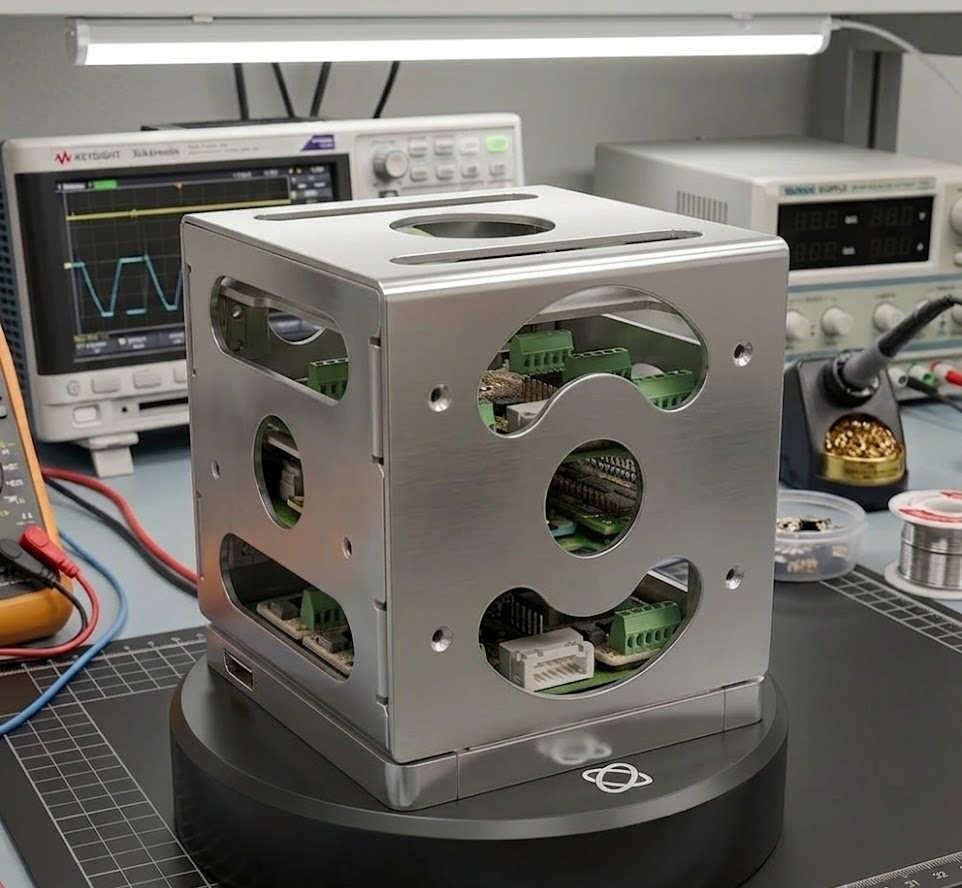
Orbit2Orbit uses a modular 1–4U payload architecture (1U, 2U and 4U options) designed to simplify integration across compatible flight platforms.
Managed all the way to space
Our team supports payload definition, integration, readiness reviews, launch coordination, mission operations, orbital deployment and data delivery.
A fully functional system prototype is demonstrated in a relevant environment.
Flight heritage that de-risks your space mission.
Every Lab2Space flight is an opportunity to prove your technology in a real environment, build flight heritage and increase TRL before you commit to a full space mission.
Confidence
Fly your technology in real conditions and earn flight heritage.
That evidence increases your TRL and strengthens your case for orbital deployment, funding and customer confidence.
Derisk
Find the small failures on Earth, not in orbit.
Most space missions fail from small, overlooked issues. A $1 seal or a $0.10 fastener can destroy a $5M mission. Lab2Space lets you find those mistakes, recover the payload and fix it before it matters.
Six steps from first conversation to next mission.
- STEP 01Tell us what you are developing.
- STEP 02Define what the mission needs to prove.
- STEP 03Select the most appropriate flight environment.
- STEP 04Prepare and integrate the payload.
- STEP 05Fly the mission and collect data.
- STEP 06Review the results and plan the next development stage.
You do not need to begin with the highest or most expensive flight environment. Lab2Space helps identify the most practical next test for your technology.
Choose the environment that matches your next test.
High-Altitude Flight
Early flight validation for sensors, communications systems, imaging equipment and atmospheric research payloads.
- Sensor testing
- Communications testing
- Imaging
- Atmospheric data collection
- Early hardware validation
- Operational rehearsal
Stratospheric Flight
Extended exposure to low pressure, reduced temperature and near-space environmental conditions.
- Thermal behaviour
- Materials testing
- Radiation exposure
- Electronics validation
- Environmental monitoring
- Long-duration payload operation
Suborbital Flight
Short-duration access to high altitude, launch loads and microgravity before committing to orbital deployment.
- Microgravity research
- Launch-load validation
- Pharmaceutical experiments
- Biological experiments
- Technology demonstrations
- Pre-orbital validation
Payloads Lab2Space supports today.
Not sure whether your payload is suitable? Submit a preliminary mission enquiry and the Orbit2Orbit team will assess the most appropriate pathway.
Lab2Space is more than access to a flight.
Every mission includes the engineering and coordination work required to turn a payload concept into flight data.
- Preliminary payload assessment
- Mission-objective definition
- Flight-environment selection
- Payload interface definition
- Mechanical and electrical integration
- Technical and safety readiness reviews
- Launch-provider coordination
- Mission operations
- Telemetry and data collection
- Payload recovery where applicable
- Post-flight reporting
- Planning for the next mission stage
Upcoming Lab2Space flights
The next flight opportunities on the Lab2Space manifest.
Compare available payload capacity and request a place on the mission most suited to your technology.
How booking requests work
A booking is a request for payload capacity. Orbit2Orbit reviews every request; capacity is not confirmed until we issue written acceptance.
Frequently asked questions.
Can't find what you need? Talk to the Orbit2Orbit team directly.
Ready to move your technology beyond the laboratory?
Tell Orbit2Orbit what you are developing, what you need to prove and when you need to fly.